
One wrong prayer switch, and your opponent lands a powerful special attack. A few seconds later, you’re back at the bank without your gear.
Hardcore PvP on RuneScape private servers can be brutal. Some servers offer quick fights near Edgeville, while others attract clans to deep Wilderness locations or run tournaments with special combat rules. But finding a server with PvP features is one thing. Finding opponents worth fighting is another.
What Makes an RSPS Wilderness Worth Fighting In?
A server can have hundreds of players online and an almost empty Wilderness. Many may be busy training skills, killing bosses, or trading.
For PvP players, a better sign is how often fights happen and where players gather.
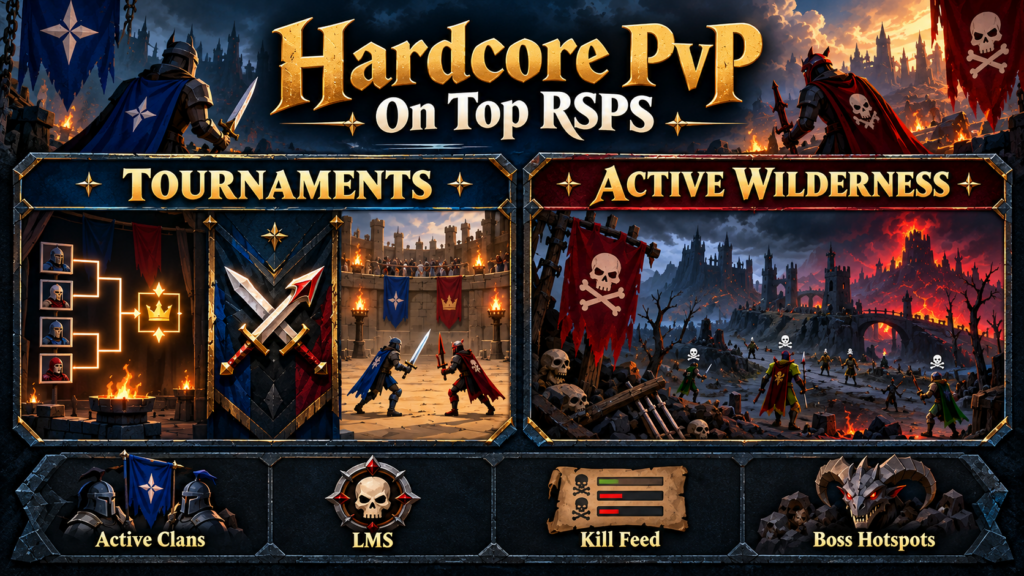
You can get engaged in RSPS on the server to compare servers that offer Wilderness activities, tournaments, and clan combat. Then look at recent event announcements, kill feeds, or PvP leaderboards to see whether those features attract players.
An active PvP server usually has several places where fights develop:
- Edgeville: Commonly used for quick 1v1 fights, especially on servers with convenient banking and teleports.
- Deep Wilderness: More dangerous encounters involving stronger opponents, PKing teams, and larger combat-level ranges.
- Revenant Caves: Valuable monster drops can attract PvM players and the PKers hunting them.
- Wilderness bosses: Players fighting monsters may be interrupted by solo PKers or organized groups.
- Clan hotspots: Multi-combat locations where several players can attack the same opponent.
You should also consider when these places become active. A server with regular evening tournaments may be more enjoyable than one with a larger player count but few organized fights.
PvP Tournaments and the Combat Skills They Test
Tournaments give players a different experience from open Wilderness fights. Instead of searching for opponents, you enter an organized competition with match rules, equipment requirements, and a way to determine the winner.
Some servers automate these events, while others organize them through staff or community schedules.
Pure, Main, and Hybrid Tournaments
Not every PvP build performs the same way.
A pure character usually keeps Defence low while developing offensive combat skills. This allows the player to deal strong damage at a relatively low combat level, although they sacrifice access to stronger defensive equipment.
Main accounts have more balanced or higher combat stats, giving them access to a wider range of weapons, armor, and prayers.
Hybrid tournaments place more emphasis on switching combat styles during a fight.
|
Tournament Type |
Main Challenge |
|
Pure |
High damage with limited defensive equipment |
|
Main |
Managing damage, supplies, and a wider range of combat options |
|
Hybrid |
Switching between Magic, Ranged, and melee |
|
NH / Tribrid |
Using protection prayers, freezes, and all three combat styles |
NH stands for No Honour. In this style of combat, players commonly use methods that may be restricted in traditional arranged fights, such as protection prayers and freezing spells. A tournament can restrict specific weapons or use preset equipment to keep the competition balanced.
Last Man Standing Tournaments
Last Man Standing (LMS) follows a survival format. In official OSRS, players enter a separate arena without risking their own equipment. They receive combat supplies and fight other participants until only one survives. Winning fights provides opportunities to obtain stronger equipment.
RSPS versions may change the starting gear, player limits, or rewards, but the main idea remains similar.
LMS requires players to make several decisions during one match. They must defeat their first opponent, manage equipment upgrades, and prepare for later fights against players who may have stronger gear.
For someone learning PvP, standardized starting equipment can be especially useful. Success relies more on combat decisions than on the value of items stored in the bank.
Clan Tournaments and Team Coordination
Clan tournaments turn individual PvP into a team fight where coordination matters as much as combat skills. In multi-combat areas, several players can attack the same opponent, making organized teams especially dangerous.
Players often take different roles during a fight:
- Callers choose targets and tell teammates when to switch opponents.
- Freezers use spells like Ice Barrage to stop enemies from moving.
- Damage dealers focus melee and Ranged attacks on the same target.
- Scouts track enemy movements and warn the team about approaching clans.
Even a smaller clan can defeat a larger group with well-timed attacks and good communication.
Tournament rules may set team-size limits, restrict equipment, or use elimination brackets where one lost match ends a team’s run.
Tournament Rewards and Entry Rules
Rewards can include in-game currency, valuable items, or positions on PvP leaderboards. Their value depends on the server’s economy and event rules.
Before entering, check whether participants bring personal equipment, whether deaths cause item loss, and how the prize is distributed.
Competitive gaming websites also differ in how they handle rewards. For example, https://www.csgopromocode.com/ offers promotions in the CS-related gaming market rather than rewards earned through RSPS combat. These systems serve different purposes and come with different conditions.
For an RSPS tournament, the most useful information is the match schedule, entry requirements, and results from previous events.
How Wilderness Levels, Skulls, and Combat Zones Affect Risk
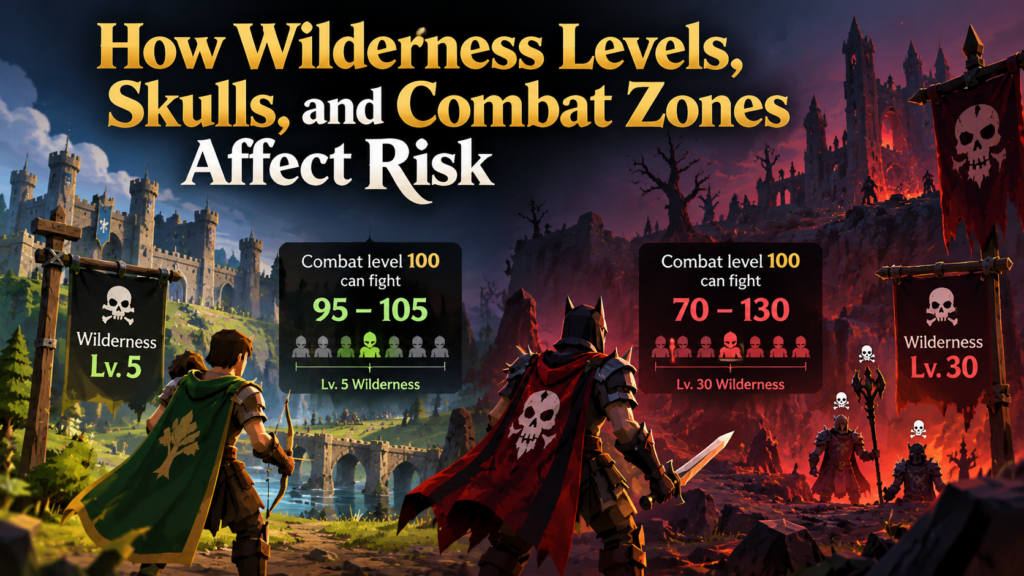
Wilderness combat has rules that make it different from ordinary PvP arenas. The deeper you travel, the wider the range of players who can attack you.
In standard OSRS, a combat level 100 player in level 5 Wilderness can fight opponents between levels 95 and 105. At Wilderness level 30, the possible range expands to combat levels 70 through 130.
A low-Defence pure that performs well near Edgeville may therefore face much stronger opponents farther north.
Single-Combat vs Multi-Combat Areas
In single-combat areas, only one player can attack a target at a time. Multi-combat zones allow several players to attack the same opponent, making them much more dangerous for solo PKers.
The main differences are:
- Single-combat: Fights focus on prayer switching, weapon timing, and individual skill.
- Multi-combat: Clans can combine damage, freeze targets, and coordinate attacks to secure kills.
- PJ timer: In official OSRS, this prevents another player from immediately interrupting certain single-combat fights. RSPS may use different rules.
Before entering deep Wilderness, check where multi-combat zones begin. Crossing that boundary can turn a manageable 1v1 fight into an encounter with an entire clan.
Skull Mechanics and Item Protection
In traditional OSRS Wilderness combat, attacking another player without the relevant protection can give your character a skull.
A skulled player normally loses all carried and equipped items on death unless an item-protection mechanic applies. An unskulled player generally keeps their three most valuable eligible items, with exceptions and additional rules.
Private servers can modify skull behavior, item protection, and death penalties.
Check the equipment risk interface before entering the Wilderness. The same gear setup may be safe in one PvP arena and extremely expensive to lose elsewhere.
Teleport Limits and Escape Routes
Teleporting out of danger becomes harder as you move deeper into the Wilderness.
In official OSRS, most teleport methods stop working above Wilderness level 20. Certain items, including the Amulet of Glory, can work up to level 30.
Teleport Block can prevent a player from teleporting even when they are within the permitted Wilderness level. Freezing spells add another problem. A player caught by Ice Barrage may be unable to move while the opponent continues attacking.
These restrictions make defensive supplies important. Food, Saradomin brews, restore potions, and affordable equipment can help reduce the risk of a costly death.
Combat Mechanics That Separate Skilled PKers From Beginners
High combat levels won’t automatically win a PvP fight. Weapon timing, prayer switches, and equipment changes can be more important.
OSRS uses a game-tick system, with each standard tick lasting approximately 0.6 seconds. Actions happen according to these timing rules, so experienced players learn when attacks can land and when to change equipment.
Special Attacks and KO Timing
A KO (knockout) happens when you deal enough damage to finish an opponent before they can heal. Timing your special attack is often more important than the weapon itself.
Common PvP tactics include:
- Dragon dagger: Delivers two hits with one special attack.
- Armadyl godsword: Deals heavy damage and is often used to finish a fight.
- Weapon switching: Moves from Ranged attacks to a melee special attack to catch opponents off guard.
- Prayer prediction: Anticipates when an opponent will switch protection prayers.
Experienced PKers save special attack energy for the right moment rather than using it as soon as it’s available.
Prayer Switching and Tribridding
Tribridding uses Magic, Ranged, and melee during the same fight.
A player may begin with Ice Barrage to freeze an opponent, switch to a crossbow, and then use a melee weapon when the opponent changes protection prayers. Defending against this requires recognizing the weapon being used and choosing the correct protection prayer.
Accurate combat timing matters here. If an RSPS handles attack speeds or equipment changes differently from OSRS, familiar strategies may need adjustment. Servers with accessible PvP equipment presets make these mechanics easier to practice without first spending hours collecting gear.
RSPS Servers That Feature PvP Tournaments and Wilderness Content
Several established names on MoparScape advertise PvP-focused features. Each offers a different combination of tournaments, Wilderness activities, and combat systems. These descriptions reflect their published listings, rather than independently measured player activity.
Roat Pkz
Roat Pkz promotes automatic tournaments, Last Man Standing, Bounty Hunter, custom equipment kits, and Wilderness PvP. Its listing also describes Edgeville fighting, risk zones, and Revenant Cave activities.
The combination makes it worth examining if you want quick equipment access alongside organized PvP events.
RuneWild
RuneWild advertises PvP leagues, tournaments, Wilderness activities, and support for single-combat and multi-combat clans.
Its listing also mentions PvP tasks. These can offer players objectives beyond searching for random fights, depending on how the server implements them.
PkHonor
PkHonor lists Last Man Standing, Wilderness updates, and OSRS-inspired PvM content.
It may appeal to players who want access to PvP activities while also spending time on bosses, skills, and other long-term content.
SpawnPvP
SpawnPvP promotes instant access to PKing, home-area safe PvP, equipment presets, Wilderness activities, and scheduled tournaments.
Its listing describes an open beta, so checking current development progress and event participation is particularly important.
For each server, recent Discord announcements, event results, and actual in-game activity provide more useful information than promotional claims about being the biggest or most active.
New RSPS and the Advantage of Early PvP Competition
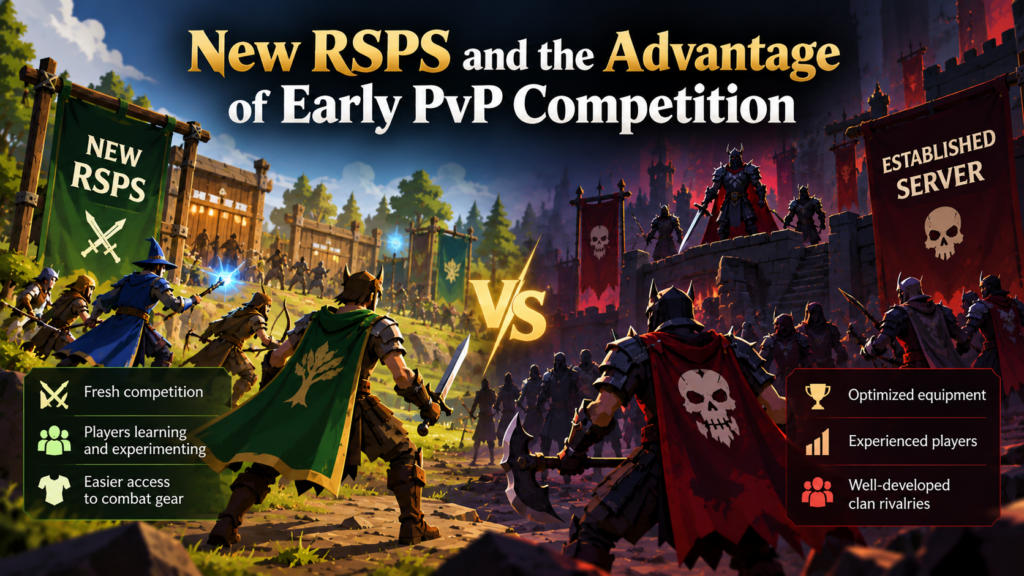
Joining an established server often means facing players who already have optimized equipment and years of experience.
A new RSPS may offer a different environment, especially if it gives players quick access to combat gear.
During the opening period, many players are still experimenting with builds and learning the server’s combat rules. Clan rivalries may also be developing.
However, launch activity does not always last.
On an economy-based server, PvP may develop slowly because players first need to train their accounts and obtain equipment. Spawn-style servers can reduce that barrier with ready-made combat setups.
The important distinction is whether a new server has a working PvP system and enough regular participants to support it.
A crowded launch day says little about how active tournaments and Wilderness encounters will be several weeks later.
How to Find a PvP Server That Offers Regular Fights
A server with many features can still deliver a poor combat experience if its tournament queues are empty or its combat mechanics behave inconsistently.
Before spending serious time on one, try a few simple checks.
- Visit Edgeville or the main PvP area. Look for players fighting rather than standing around waiting for an event.
- Open the tournament interface. Check upcoming events, available formats, and how many players are joining.
- Try a low-risk fight. Test prayer switching, weapon changes, and special attack timing.
- Explore Wilderness hotspots. Look for activity around bosses, Revenants, or other reward locations.
- Check recent PvP results. Current leaderboards and completed tournaments can help reveal whether competitive play happens regularly.
A server can also have excellent PvP mechanics but a small player base during your normal gaming hours. Testing it at the time you usually play gives you a more realistic impression.
Where to Find the Best Hardcore PvP Experience
For quick one-on-one fights, look for populated Edgeville combat areas and easy access to equipment. Organized tournaments and LMS suit players who enjoy defined rules and competitive matches.
Deep Wilderness and multi-combat zones provide a different challenge, especially when clans fight over dangerous locations or valuable PvM rewards.
The strongest RSPS PvP communities give players reasons to return for another fight. Regular opponents, reliable combat mechanics, and tournaments that actually take place matter far more than a long feature list.