
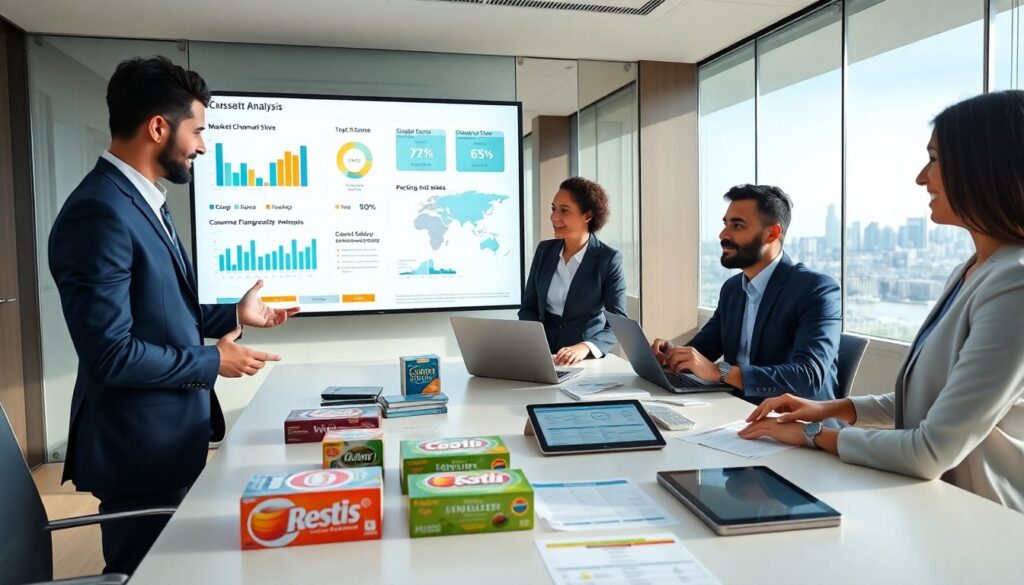
CPG market analysis shows faster retail shifts in 2026. The report highlights demand changes, channel shifts, and cost pressures. It shows where brands can grow. The following sections list market size, consumer segments, and clear brand actions.
Key Takeaways
- CPG market analysis reveals global sales nearing $3.5 trillion in 2026, driven by inflation, income trends, and e-commerce growth.
- Brands must leverage CPG market analysis to optimize pricing, channel mix, and product assortment for better shelf recall and online visibility.
- Consumer demand shifts toward health, sustainability, convenience, and segmented targeting require brands to adapt product offerings accordingly.
- Supply chain agility, including diversified suppliers and improved forecasting, is critical to reducing costs and preventing stockouts in the CPG market.
- Technology investment enhances efficiency and promotional ROI by improving inventory management and predictive analytics.
- Execution through rapid planning, testing, and iteration enables brands to capture market share amid evolving retail dynamics revealed by CPG market analysis.
Market Overview: Size, Growth Dynamics, and Macro Drivers
CPG market analysis records steady global expansion in 2026. Analysts estimate global CPG sales near $3.5 trillion. Inflation affects pricing, and income trends shape volume. Retailers adjust assortment to protect margin. E-commerce gains share, and fast-moving channels absorb new brands.
Supply chains remain central to the CPG market analysis. Companies face freight cost volatility, and they adapt by shifting suppliers and using regional distribution hubs. Packaging costs rise where raw material prices climb. Firms that lock in contracts and improve forecast accuracy reduce disruption.
Regulation also shapes the CPG market analysis. Governments tighten labeling rules and enforce sustainability targets. Brands that report emissions and reduce plastic waste win shelf access. Tax policy and trade rules shift cost lines and change import patterns.
Demographics alter demand in the CPG market analysis. Aging populations raise demand for health products. Younger buyers push plant-based and functional offerings. Urbanization increases on-the-go consumption. Brands that map demographic shifts plan production and marketing more effectively.
Technology drives efficiency in the CPG market analysis. Automated warehouses cut handling time. Data platforms improve inventory turns. Retailers use machine learning to predict promotions. Brands that invest in data see lower out-of-stocks and higher promotional ROI.
Consumer Trends and Segmentation: Where Demand Is Growing
CPG market analysis shows clear consumer shifts in 2026. Health matters more, and buyers choose products with clear benefits. They read labels and prefer clean ingredients. Many pay more for perceived health gains. Value buyers still seek discounts and large packs.
Sustainability affects the CPG market analysis. Consumers prefer recyclable packaging and shorter supply chains. They reward brands that show measurable impact. Social media amplifies these choices and speeds trend adoption.
Convenience shapes the CPG market analysis. Ready-to-eat formats and multi-use packs grow faster. E-commerce demand makes single-serve and subscription formats more profitable. Urban shoppers buy smaller quantities and pick delivery over trips to store.
Segmentation refines targeting in the CPG market analysis. High-frequency buyers respond to loyalty offers. Occasional buyers respond to trial sizes and heavy promotion. Premium buyers respond to brand stories and provenance. Brands that match offer to segment see higher conversion rates.
Price sensitivity shows in the CPG market analysis. Rising living costs push some buyers to private label. Others maintain premium spend for specific categories. Retailers adjust shelf space between national brands and private labels to balance margin and traffic.
Regional differences appear in the CPG market analysis. Emerging markets show faster volume growth. Mature markets show flat volume and higher per-unit prices. Brands expand in growth regions with localized products and adjusted price points.
Actionable Strategies For Brands: Positioning, Pricing, And Channel Mix
Brands must use CPG market analysis to set clear strategies. They must choose a focused value proposition. They must state product benefits in simple terms. Clear claims improve shelf recall and online search performance.
Brands must set data-driven prices from the CPG market analysis. They must track cost inputs and competitor moves. They must run small price tests across channels. They must use promotions to win trial but protect long-term margin.
Channel mix must reflect the CPG market analysis. Brands must balance supermarket, convenience, and e-commerce. They must place high-frequency SKUs in physical stores. They must offer subscriptions and bundles online. They must use marketplaces for reach and brand sites for margin.
Product assortment must follow the CPG market analysis. Brands must cut slow-moving SKUs. They must expand fast formats such as single-serve or multi-use packs. They must add clear premium lines where demand exists. Lean assortments reduce inventory cost and improve display clarity.
Supply actions draw from the CPG market analysis. Brands must diversify suppliers and hold strategic safety stock. They must invest in demand forecasting tools. They must shorten lead times with local partners. These moves reduce stockouts and lost sales.
Marketing must mirror findings in the CPG market analysis. Brands must use short video and search ads to drive trial. They must use loyalty offers for repeat purchase. They must measure campaigns with weekly sales and share-of-search metrics. Fast feedback loops help optimize spend.
Product innovation must align with the CPG market analysis. Brands must create simpler ingredient lists and clearer claims. They must test small-batch launches and scale winners quickly. Rapid iteration keeps the product line relevant.
Talent and organization must adapt to the CPG market analysis. Brands must hire digital marketers and data analysts. They must create cross-functional teams to speed decisions. Teams that act faster bring products to market ahead of competitors.
Execution matters more than strategy in the CPG market analysis. Brands that plan, test, and iterate win shelf space and online visibility. They that move faster capture share during market shifts.